
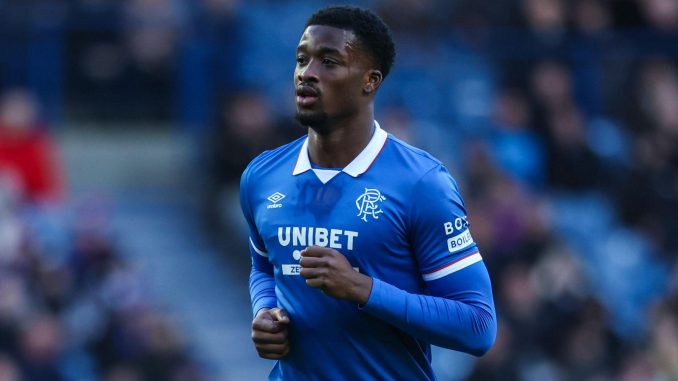
“A House Divided No More”: Danny Röhl Names Emmanuel Fernandez Captain to Heal Rangers’ Dressing Room
For weeks, whispers echoed off the Ibrox walls. Not of title races or European nights—but of fractures. Of cliques forming in the cold of the training ground. Of voices pulling in different directions. Today, those whispers meet a very public answer.
Rangers head coach Danny Röhl has officially named Emmanuel Fernandez as the club’s new captain. And in a stark, unflinching press conference this morning, Röhl did something rarely seen from a modern manager: he admitted the decision was driven by dressing room division.
“I didn’t choose Emmanuel simply because he is the best player,” Röhl said, leaning forward. “I chose him because our squad was becoming two groups. One side wanted quick, transitional football. The other wanted control. Voices grew loud, then louder. Respect began to fade. I needed one voice—one man—that every single player trusts. That man is Emmanuel Fernandez.”
It is a stunning admission from a coach usually measured in his words. But those close to the club describe a recent behind-closed-doors friendly where two senior players reportedly clashed over tactical responsibility mid-game, with teammates forced to separate them. Röhl confirmed no punch was thrown, but added: “The trust had a wound.”
Enter Fernandez. The 26-year-old central defender, signed two seasons ago, has never sought the spotlight. He is not the fastest, nor the most technical. But ask any analyst who tracks Ibrox’s internal metrics: Fernandez leads every measurable category for verbal organisation and post-ruck cohesion. More tellingly, in anonymous player polling conducted by the club’s leadership group, Fernandez received 87% of votes as “the teammate I would follow into a difficult match.”
Röhl highlighted three specific reasons for the change of armband:
1. Neutrality in style. Fernandez doesn’t belong to the “counter-press” camp nor the “possession” camp. He bridges them. In training, he translates Röhl’s instructions seamlessly to both factions.
2. Accountability. After last month’s 2–2 draw at Tynecastle, Fernandez was the only player who publicly (and privately) took full blame for a marking error—even though stats blamed the left-back. “That,” Röhl said, “silenced the finger-pointing culture overnight.”
3. Language. Bilingual in English and Spanish, Fernandez mediates between the British core and the growing South American contingent. Röhl noted that “translation apps don’t win tackles. Trust does.”
The former captain, whose name the club has asked outlets to withhold “out of respect for his service,” was informed on Monday. Röhl described that conversation as “painful but honest.” The ex-skipper will remain in the leadership group but has accepted a reduced role.
Reaction in the dressing room? According to a source close to the squad, the morning after the announcement, Fernandez did not give a speech. Instead, he quietly changed the music in the gym from two competing playlists to a single shared one—then led the warm-up without a single instruction. By lunch, four players who hadn’t spoken in three weeks were reviewing video together.
“That,” Röhl smiled, “is captaincy.”
Make no mistake: this is a gamble. Fernandez has never lifted a major trophy as captain. But in a season where Rangers have drawn five matches they should have won—matches Röhl blames on “on-field indecision”—the head coach has decided that unity is not a soft skill. It is a tactical weapon.
As the gaffer rose to leave, he offered one final line, clipped and certain:
“Talented teams lose finals. United teams lift trophies. Emmanuel Fernandez is not my choice because he’s the loudest. He’s my choice because when he speaks, everyone else finally stops whispering.”
The armband has been passed. Now we wait to see if Ibrox finally pulls in one direction.
Leave a Reply